
Your price
By Rogério Melfi, IA4FIN ambassador.
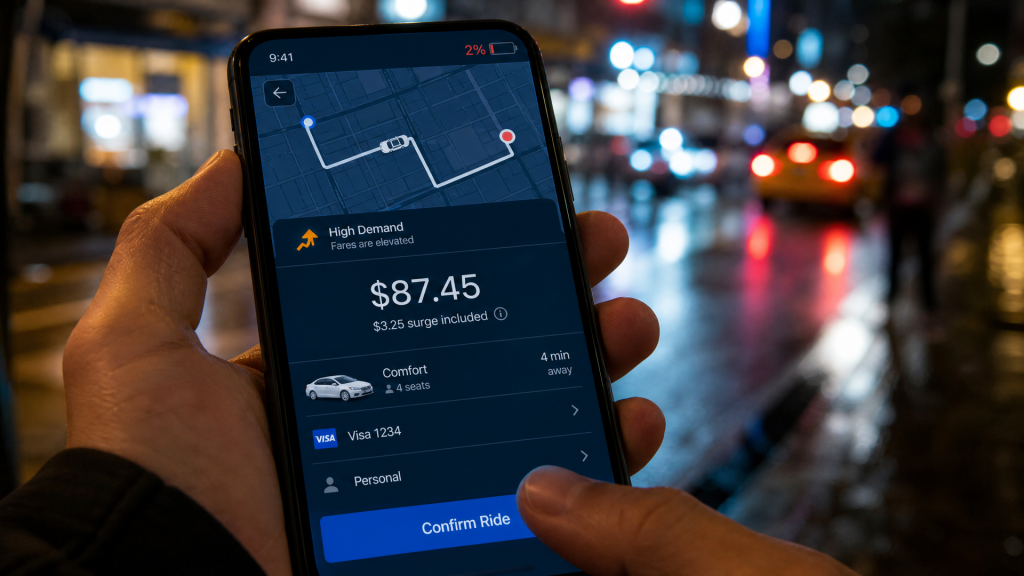
At an IA4FIN lunch, someone mentioned the hypothesis that a ride-hailing app could charge more when a user’s phone battery was about to die. The logic would be simple: someone with only 2% battery is unlikely to close the app to look for another alternative. Urgency increases, and with it the willingness to accept a higher price.
There is no evidence that this happens. Some apps have even denied using this kind of information to set prices.
The conversation revolved around the question: would this be technically possible? We have stopped finding it strange that price depends less on the product and increasingly on who is buying.
We are talking about an evolution of dynamic pricing. Airlines and hotels already use algorithms to adjust prices according to factors such as demand, seasonality, advance purchase and availability. Consumers have, in a way, incorporated this logic. They expect to pay more on a holiday, during a major event or when buying a ticket at the last minute.
Artificial intelligence, however, adds a new dimension to this equation. Instead of observing only the market, it also begins observing human behavior.
In practice, we are turning decades of behavioral economics research into production systems. For a long time, researchers sought to understand why people do not always make perfectly rational decisions, how urgency influences a purchase, why we avoid losses, how much we value convenience and how we react to discounts. Now these same patterns cease to be merely subjects of academic study and begin feeding algorithms that continuously learn from millions of real decisions.
Algorithms do not learn only when we buy. Above all, they learn how we decide. They discover how long we take to complete a purchase, under what circumstances we abandon it, when we accept paying more for convenience and when we wait for a discount. Every interaction produces small signals that seem irrelevant in isolation. Together, they form a fairly precise picture of our willingness to pay.
In financial markets, this transformation can have consequences. Unlike an airline ticket or hotel room, financial products have always been personalized to some extent. But this personalization was built around relatively homogeneous customer groups. Loan rates, card limits, insurance premiums and even investment offers already vary according to customer characteristics, especially their ability to pay and risk profile.
The evolution of artificial intelligence expands this logic. Beyond estimating financial risk, it begins understanding how each person makes decisions. Some customers value speed more than price. Others spend hours comparing offers to save a few basis points on interest rates. Some accept a higher fee for convenience, while others change institutions over minimal cost differences. Behavior becomes another model variable. Price no longer reflects only risk; it also reflects how each consumer decides.
AI reduces segment size until it contains only one customer: you.
And if artificial intelligence increasingly understands consumer behavior, the natural response will be to deploy another artificial intelligence to represent consumers. Instead of a person negotiating with a bank’s, insurer’s or digital platform’s algorithm, we will see AI agents negotiating with one another. One agent will seek to maximize institutional revenue. The other will defend customers’ interests, comparing offers, negotiating rates, evaluating alternatives and choosing the best moment to enter a contract.
I believe artificial intelligence itself can create balance in this new scenario. If companies use agents capable of learning how we buy and negotiate, consumers will also need agents capable of learning how institutions sell and set prices. Open Finance represents an important step in this direction by returning control over data to customers. Agents may represent the next step: returning negotiating power to them.
In a not-too-distant future, I will not be the one negotiating a loan, taking out insurance, choosing an investment or buying an airline ticket. Our agents will do that for us. On the other side, another agent will try to maximize institutional revenue.
Perhaps I will never discover whether an app raised prices because my battery was dying. But just in case, it is better to keep the battery above 50%.
📌 Originally published in IA4FIN